
CI/CD: DevEx Survey Questions to Help Teams Diagnose Pipeline Friction

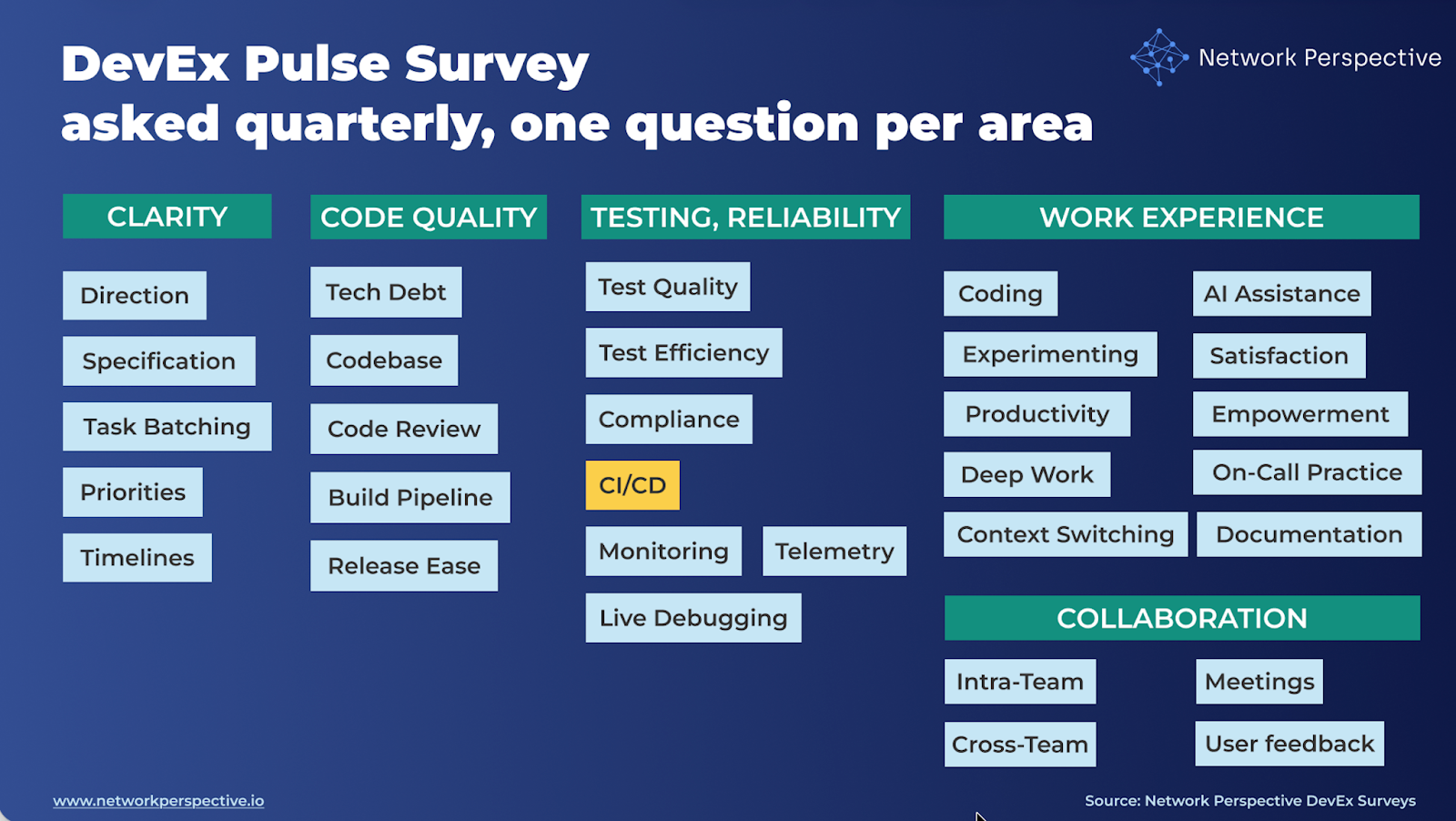
In our DevEx AI tool, we use two sets of survey questions: DevEx Pulse (one question per area to track overall delivery performance) and DevEx Deep Dive (a focused root-cause diagnostic when something needs attention).
DevEx Pulse tells us where friction is. DevEx Deep Dive tells us why it exists.
Let’s take a closer look at CI/CD. If the Pulse question “Our CI/CD tools are fast and reliable” receives low scores and developers’ comments reveal significant friction and blockers, what should you do next?
Here are 13 deep dive questions you can ask your developers to uncover the causes of friction in CI/CD, along with guidance on how to interpret the results, common patterns engineering teams encounter, and practical first steps for improvement. This will help you pinpoint what’s causing the problem and fix it on your own, or move faster with our DevEx AI tool and expert guidance.
CI/CD — DevEx Survey Questions for Engineering Teams
The real question is: Does CI/CD help changes move forward smoothly — or does it slow work down with waiting, failures, and reruns?
Deep dive questions should help you map how code review flows through your delivery process and identify where it breaks down:
Speed → Feedback → Stability → Failure Clarity → Recovery → Ownership → Cost
Here’s how the DevEx AI tool helps uncover this.
Speed
Does CI/CD finish quickly?
- Fast / CI/CD runs usually finish fast enough to keep work moving.
- ETA / It’s usually clear how long a CI/CD run will take.
Blocking
Does CI/CD block work?
- Not blocking / Work doesn’t often stop while waiting for CI/CD to finish.
- Early / CI/CD failures usually show up early, not at the very end.
Reliability
Does CI/CD fail for real reasons?
- Stable / CI/CD usually passes when the code is correct.
- Not flaky / CI/CD doesn’t fail randomly or for unclear reasons.
Failures
Are failures easy to handle?
- Clear fail / When CI/CD fails, it’s clear what went wrong.
- Clear fix / It’s usually clear what needs to be fixed when CI/CD fails.
Recovery
Can CI/CD be fixed quickly?
- Quick recover / CI/CD problems are usually fixed quickly.
- No reruns / CI/CD rarely needs to be rerun just to get a clean result.
Care
Is CI/CD looked after?
- Owned / It’s clear who owns and maintains CI/CD.
- Improved / CI/CD is improved over time, not just fixed when broken.
Effort
- Weekly / Thinking about waiting for CI/CD runs, rerunning pipelines, investigating failures, or fixing CI/CD problems — about how much time is spent in a typical week dealing with this?
- None
- Less than 1 hour
- 1–2 hours
- 3–5 hours
- 6–10 hours
- More than 10 hours
Open-ended question (for comments)
Ideas to spot or reduce friction?
How to Analyze DevEx Survey Results on CI/CD?
Does CI/CD help changes move forward smoothly — or does it slow work down with waiting, failures, and reruns? Here’s how the DevEx AI tool helps make sense of the results.
How to Read Each Section
Speed
Questions
- Fast – CI/CD runs usually finish fast enough to keep work moving
- ETA – It’s usually clear how long a CI/CD run will take
What this section tests
Whether CI/CD is fast and predictable, or slow and hard to plan around.
How to read scores
- Fast ↓, ETA ↓
→ CI/CD is slow and unpredictable. - Fast ↑, ETA ↓
→ CI/CD can be fast, but timing is unclear. - Fast ↓, ETA ↑
→ CI/CD is known to be slow and planned around.
Key insight
Slow or unpredictable CI/CD turns finished work into waiting time.
Open-ended comments – how to read responses
- “Takes forever” → slow pipelines
- “No idea when it finishes” → unclear timing
- “Hard to plan around runs” → speed pain
Key insight
Waiting on CI/CD is one of the biggest hidden delivery costs.
Blocking
Questions
- Not blocking – Work doesn’t often stop while waiting for CI/CD
- Early – CI/CD failures usually show up early, not at the very end
What this section tests
Whether CI/CD blocks progress, or gives early feedback that allows work to continue.
How to read scores
- Not blocking ↓, Early ↓
→ CI/CD blocks work and fails late. - Not blocking ↑, Early ↓
→ Work continues, but problems appear too late. - Not blocking ↓, Early ↑
→ Early failures help, but CI/CD still blocks progress.
Key insight
Late CI/CD failures waste more time than slow runs.
Open-ended comments – how to read responses
- “Fails at the end” → late signal
- “Blocked until pipeline finishes” → work stoppage
- “Surprises after waiting” → timing problem
Key insight
Early feedback matters more than fast feedback.
Reliability
Questions
- Stable – CI/CD usually passes when the code is correct
- Not flaky – CI/CD doesn’t fail randomly or for unclear reasons
What this section tests
Whether CI/CD fails for real reasons, or creates noise.
How to read scores
- Stable ↓, Not flaky ↓
→ CI/CD is noisy and unreliable. - Stable ↑, Not flaky ↓
→ Code is fine, but CI/CD fails randomly. - Stable ↓, Not flaky ↑
→ Failures are real, but happen often.
Key insight
Flaky CI/CD trains teams to ignore failures.
Open-ended comments – how to read responses
- “Fails, then passes on rerun” → flakiness
- “Green doesn’t mean safe” → lost trust
- “Just rerun it” → normalized noise
Key insight
Unreliable CI/CD slows decisions and reduces confidence.
Failures
Questions
- Clear fail – When CI/CD fails, it’s clear what went wrong
- Clear fix – It’s usually clear what needs to be fixed
What this section tests
How easy it is to understand and fix CI/CD failures.
How to read scores
- Clear fail ↓, Clear fix ↓
→ Failures cause long investigations. - Clear fail ↑, Clear fix ↓
→ Problems are known, but fixes aren’t clear. - Clear fail ↓, Clear fix ↑
→ Fixes exist, but failures are confusing.
Key insight
Hard-to-understand failures waste time and break flow.
Open-ended comments – how to read responses
- “Logs don’t help” → unclear failure
- “Trial and error” → missing signals
- “Ask someone else” → knowledge bottleneck
Key insight
Clear failure messages are essential for fast recovery.
Recovery
Questions
- Quick recover – CI/CD problems are usually fixed quickly
- No reruns – CI/CD rarely needs to be rerun just to get a clean result
What this section tests
Whether CI/CD can be fixed quickly, or drags on.
How to read scores
- Quick recover ↓, No reruns ↓
→ CI/CD problems linger and require retries. - Quick recover ↑, No reruns ↓
→ Fixes exist, but reruns are common. - Quick recover ↓, No reruns ↑
→ Reruns aren’t common, but fixes are slow.
Key insight
Slow recovery multiplies the cost of every CI/CD failure.
Open-ended comments – how to read responses
- “Takes days to fix” → slow recovery
- “Retry until green” → rerun culture
- “Pipeline stuck broken” → lingering issues
Key insight
Fast recovery matters more than avoiding every failure.
Care
Questions
- Owned – It’s clear who owns and maintains CI/CD
- Improved – CI/CD is improved over time, not just fixed when broken
What this section tests
Whether CI/CD is actively cared for, or left to decay.
How to read scores
- Owned ↓, Improved ↓
→ CI/CD is nobody’s job. - Owned ↑, Improved ↓
→ Someone owns it, but has no time. - Owned ↓, Improved ↑
→ Improvements happen, but responsibility is unclear.
Key insight
CI/CD only gets better when someone owns it.
Open-ended comments – how to read responses
- “No one owns it” → neglect
- “Known problems never fixed” → lack of priority
- “Old pipeline kept alive” → decay
Key insight
Untended CI/CD always becomes slower and noisier.
Effort
Question
- Weekly – Time spent waiting for CI/CD, rerunning pipelines, chasing failures, or fixing CI/CD issues
How to read responses
- 0–1 hr/week → Healthy CI/CD flow
- 1–3 hrs/week → Some friction
- 3–5 hrs/week → Systemic drag
- 6+ hrs/week → Must-fix CI/CD problem
Key insight
Time spent dealing with CI/CD pain is the clearest cost signal.
Pattern Reading (Across Sections)
Pattern — “Slow Lane” (Very common)
Pattern:
Speed ↓ + Blocking ↓
Interpretation
CI/CD delays work more than it helps.
Pattern — “Flaky Pipe” (Very common)
Pattern:
Reliability ↓ + Recovery ↓
Interpretation
Teams waste time chasing false failures.
Pattern — “Late Pain” (Common)
Pattern:
Blocking ↓ + Failures ↓
Interpretation
Problems show up late and are hard to fix.
Pattern — “Neglected CI/CD” (Medium)
Pattern:
Care ↓ + Effort ↑
Interpretation
CI/CD issues are known but not addressed.
How to Read Contradictions (This Is Where Insight Is)
Contradiction Fast ↑, Effort ↑
CI/CD runs quickly, but failures cause rework.
Contradiction Stable ↑, No reruns ↓
CI/CD passes, but only after retries.
Contradiction Clear fail ↑, Clear fix ↓
Problems are known, but fixing them is slow.
Contradiction Owned ↑, Improved ↓
Ownership exists without capacity.
Contradictions show where CI/CD looks fine on paper but hurts in practice.
Final Guidance — How to Present Results
What NOT to say
- “CI/CD is broken”
- “Developers rerun pipelines too much”
- “People need to be more careful”
What TO say (use this framing)
“This shows where our CI/CD system slows work instead of speeding it up.”
“The issue isn’t people — it’s speed, clarity, and recovery.”
One Powerful Way to Present Results
Show three things only:
- How long CI/CD runs take
- How often CI/CD fails for no real reason
- How many hours per week CI/CD friction costs
Using DevEx CI/CD Insights to Improve How Teams Move Changes Through the Pipeline
Here’s how the DevEx AI tool will guide you toward making first actions.
First Steps Per Section
Speed
Goal: Make CI/CD runs fast enough and predictable.
First steps
- Identify the slowest pipeline stages and measure their duration.
- Split long pipelines into parallel jobs where possible.
- Add pipeline duration visibility (expected runtime shown in CI UI).
- Run fast checks early (lint, build, unit tests).
Blocking
Goal: Reduce situations where work stops while CI/CD runs.
First steps
- Move quick feedback checks earlier in the pipeline.
- Allow local or pre-push checks for fast validation.
- Use incremental builds or caching to reduce blocking time.
- Separate fast validation pipelines from slower full pipelines.
Reliability
Goal: Ensure CI/CD failures represent real issues.
First steps
- Track flaky tests and flaky jobs explicitly.
- Introduce a flaky test quarantine or stabilization process.
- Log and analyze pipeline reruns to identify common instability sources.
- Stabilize infrastructure dependencies used in CI.
Failures
Goal: Make failures easy to understand and fix.
First steps
- Improve error messages and logs in pipeline steps.
- Highlight the failing stage clearly in CI output.
- Add links to documentation or runbooks for common failures.
- Standardize how failures are reported across pipelines.
Recovery
Goal: Reduce time spent fixing CI/CD problems.
First steps
- Define who responds when pipelines break.
- Allow rerunning only the failed stage instead of the full pipeline.
- Add alerts when pipelines stay broken for long periods.
- Maintain a simple CI/CD troubleshooting guide.
Care
Goal: Ensure CI/CD is actively maintained.
First steps
- Assign clear CI/CD ownership (team or platform group).
- Schedule regular pipeline improvement work (not only reactive fixes).
- Track pipeline health metrics (duration, failure rate).
- Encourage teams to propose CI/CD improvements.
Effort
Goal: Reduce weekly time lost to CI/CD friction.
First steps
- Measure time-to-green for pipelines.
- Identify common rerun reasons.
- Track average pipeline duration and failure frequency.
- Prioritize fixes for the highest-impact CI/CD pain points.
First Steps for Patterns
Pattern — Slow Lane
Speed ↓ + Blocking ↓
First steps
- Parallelize pipeline jobs.
- Move fast checks earlier.
- Reduce unnecessary pipeline stages.
Pattern — Flaky Pipe
Reliability ↓ + Recovery ↓
First steps
- Track flaky tests and jobs.
- Stabilize infrastructure dependencies.
- Introduce a flaky test cleanup backlog.
Pattern — Late Pain
Blocking ↓ + Failures ↓
First steps
- Move critical checks earlier.
- Add incremental validation steps.
- Fail pipelines as early as possible.
Pattern — Neglected CI/CD
Care ↓ + Effort ↑
First steps
- Assign CI/CD ownership.
- Schedule pipeline improvement work.
- Track CI/CD health metrics regularly.
First Steps for Contradictions
Contradiction Fast ↑ + Effort ↑
CI/CD runs quickly, but failures cause rework.
First steps
- Investigate common failure causes.
- Improve failure messages and logs.
- Stabilize flaky tests.
Contradiction Stable ↑ + No reruns ↓
Pipelines eventually pass but require retries.
First steps
- Identify stages commonly rerun.
- Stabilize test environments or dependencies.
- Reduce nondeterministic tests.
Contradiction Clear fail ↑ + Clear fix ↓
Failures are visible but fixing them takes time.
First steps
- Add runbooks for common failures.
- Improve documentation of CI/CD stages.
- Clarify ownership of failing components.
Contradiction Owned ↑ + Improved ↓
Ownership exists but improvements don’t happen.
First steps
- Allocate dedicated time for CI/CD improvement.
- Introduce CI/CD improvement backlog.
- Track CI/CD metrics regularly.
The Core Improvement Rule
Optimize CI/CD for fast feedback and fast recovery, not just fast pipelines.
A CI/CD system that:
- fails early,
- explains failures clearly,
- and is quick to fix
will support delivery far better than one that is only optimized for speed.
The Most Powerful First Step Overall
Move fast validation checks earlier in the pipeline.
For example:
- lint
- build
- unit tests
When these checks run early:
- failures appear sooner
- waiting time decreases
- reruns drop
- developer feedback loops shorten
This single change usually improves:
- speed
- blocking
- reliability
- recovery
- overall CI/CD effort.
There’s Much More to DevEx Than Metrics
What you’ve seen here is only a small part of what the DevEx AI platform can do to improve delivery speed, quality, and ease.
If your organization struggles with fragmented metrics, unclear signals across teams, or the frustrating feeling of seeing problems without knowing what to fix, DevEx AI may be exactly what you need. Many engineering organizations operate with disconnected dashboards, conflicting interpretations of performance, and weak feedback loops — which leads to effort spent in the wrong places while real bottlenecks remain untouched.
DevEx AI brings these scattered signals into one coherent view of delivery. It focuses on the inputs that shape performance — how teams work, where friction accumulates, and what slows or accelerates progress — and translates them into clear priorities for action. You gain comparable insights across teams and tech stacks, root-cause visibility grounded in real developer experience, and guidance on where improvement efforts will have the highest impact.
At its core, DevEx AI combines targeted developer surveys with behavioral data to expose hidden friction in the delivery process. AI transforms developers’ free-text comments — often a goldmine of operational truth — into structured insights: recurring problems, root causes, and concrete actions tailored to your environment.
The platform detects patterns across teams, benchmarks results internally and against comparable organizations, and provides context-aware recommendations rather than generic best practices.
Progress on these input factors is tracked over time, enabling teams to verify that changes in ways of working are actually taking hold, while leaders maintain visibility without micromanagement. Expert guidance supports interpretation, prioritization, and the translation of insights into measurable improvements.
To understand whether these changes truly improve delivery outcomes, DevEx AI also measures DORA metrics — Deployment Frequency, Lead Time for Changes, Change Failure Rate, and Mean Time to Recovery — derived directly from repository and delivery data. These output indicators show how software performs in production and whether improvements to developer experience translate into faster, safer releases.
By combining input metrics (how work happens) with output metrics (what results are achieved), the platform creates a closed feedback loop that connects actions to outcomes, helping organizations learn what actually drives better delivery and where further improvement is needed.
Returning to our topic — CI/CD — you can explore proven practices grounded in hundreds of interviews our team has conducted with engineering leaders, or take a look at – The Devexperts Way.

