
We Don’t Run DevEx Surveys. We Run a Delivery Improvement System.

Most organizations already know that Developer Experience surveys are valuable. They help uncover friction that engineering metrics alone cannot explain. They reveal why engineers are blocked, where work becomes frustrating, and which obstacles reduce productivity.
This is important work.
Research from DX, DORA, and many other organizations has shown that improving Developer Experience leads to better delivery outcomes, higher productivity, and happier engineering teams.
But there is a problem.
Most DevEx initiatives stop at measurement. Teams receive a report, leadership reviews the results, a few actions are discussed. Then everyone returns to work.
The survey identified problems, but the organization still needs to figure out:
- which issues matter most,
- where to start,
- who should act,
- how to coordinate improvements across teams,
- whether anything is actually getting better.
In practice, the hardest part of Developer Experience is often not measurement. It’s turning insight into coordinated action. That is the problem we set out to solve.
Traditional DevEx Helps You Understand Friction, The Next Challenge Is Acting On It
Traditional DevEx surveys provide enormous value because they help organizations move beyond delivery metrics.
Engineering metrics can tell us:
- releases are slowing down,
- reviews are taking longer,
- cycle time is increasing,
- flow is deteriorating.
But they rarely tell us why.
Developer Experience surveys add the missing context.
They help uncover:
- unclear requirements,
- slow reviews,
- difficult coordination,
- dependency bottlenecks,
- poor tooling,
- communication gaps.
This is the foundation of every successful improvement effort. You cannot solve friction you cannot see. But after working with engineering organizations, we repeatedly observed the same challenge.
Even when teams understood their friction, improvement still felt difficult. Every problem required investigation. Every improvement required prioritization. Every team had different challenges. And engineering leaders were left asking: Where should we focus first?
What Changes When Every Team Sees Its Own Delivery System
Instead of producing a report for leadership, our approach makes delivery friction visible directly to the teams experiencing it. Every team receives its own results.
Every team can see:
- where friction exists,
- what is improving,
- what is deteriorating,
- how they compare against themselves over time.
More importantly, they can immediately see the likely causes. The survey does not simply identify that a problem exists. It helps explain what engineers are experiencing and where intervention is likely to have the greatest impact.
This dramatically reduces the investigation phase. Instead of asking: What is happening? Teams can immediately begin discussing: What should we change?
Case 1: A Release Problem That Wasn’t Really a Pipeline Problem
One engineering organization identified low scores around release ease within an Internal Platforms group. At first glance, the symptoms looked familiar.
Engineers described:
- slow CI/CD pipelines,
- lengthy approval processes,
- strong QA dependencies,
- multi-repository changes,
- slow hotfix delivery.
Without additional context, many organizations would focus exclusively on pipeline optimization. But the survey results pointed toward something deeper. The underlying issue was not one bottleneck. It was accumulated coordination overhead created by architecture, process design, and dependency structures.
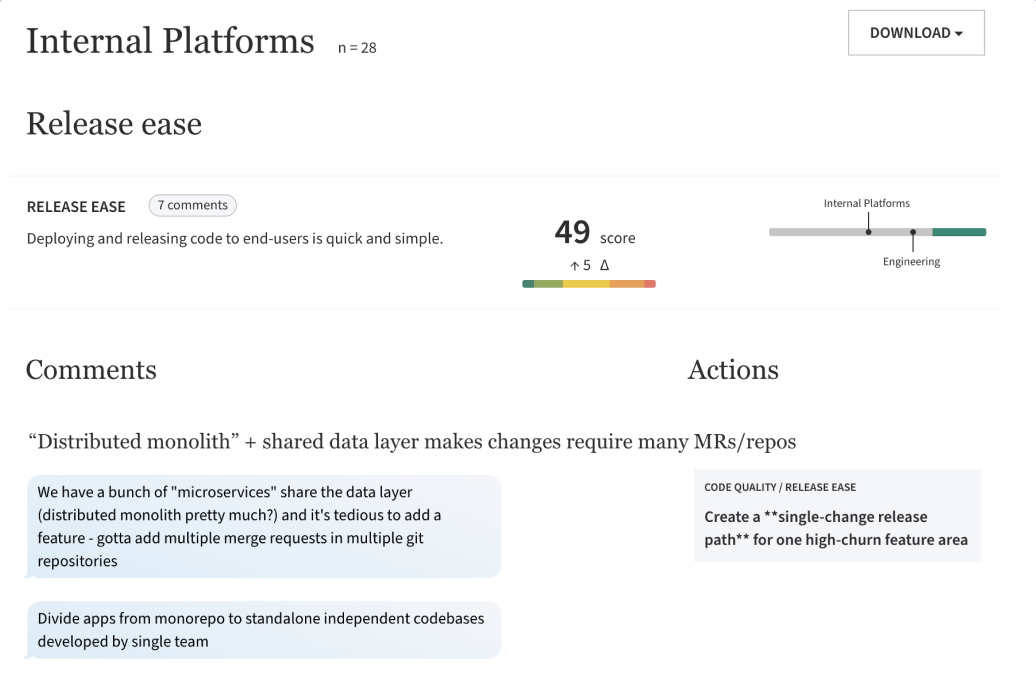
Because the root causes were visible immediately, the team was able to define concrete actions:
- pipeline optimization,
- release-path simplification,
- reduction of unnecessary checks,
- rebalancing QA dependencies.
The important point is not the specific solution. The important point is that the diagnosis was clear. The team did not spend months investigating. They moved directly into improvement.
Case 2: A Team Improved Code Reviews With One Behavioral Change
A small platform team was struggling with code review flow. Pull requests accumulated, reviews were delayed, work remained blocked.
Again, the survey revealed something that delivery metrics alone could not. The problem was not tooling, the problem was coordination.
Engineers described:
- no clear review ownership,
- inconsistent habits,
- reviews treated as secondary work.
Once the friction became visible, the intervention was remarkably simple. The team agreed that code review would become the first task of the day.
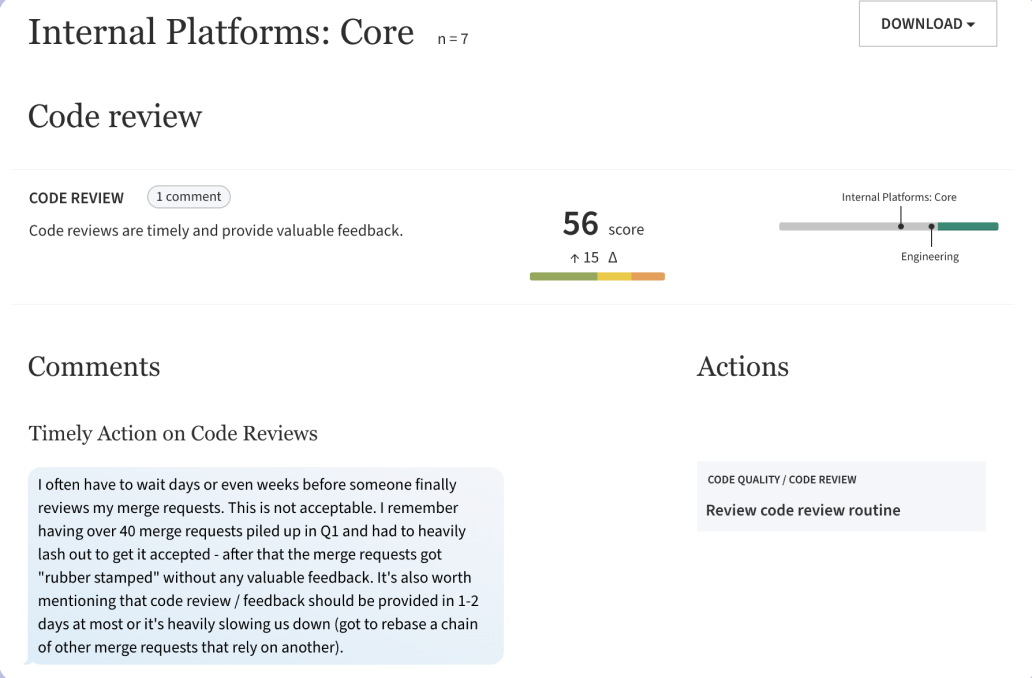
No platform migration, no process redesign, no management initiative. Just a shared behavioral adjustment. Within a few weeks, the team’s code review experience improved significantly.
This is one of the most important lessons from Developer Experience work. Many delivery problems are not hidden, they are simply not visible enough to create action.
Case 3: More Documentation Created Less Clarity
The same team later experienced a different problem. Specification clarity declined significantly. Interestingly, documentation volume had not decreased. It had increased.
Engineers described specifications that were:
- longer,
- more detailed,
- increasingly AI-assisted,
- harder to use in practice.
The issue was not missing information, the issue was declining input quality. Engineers spent more time interpreting requirements and less time executing them.
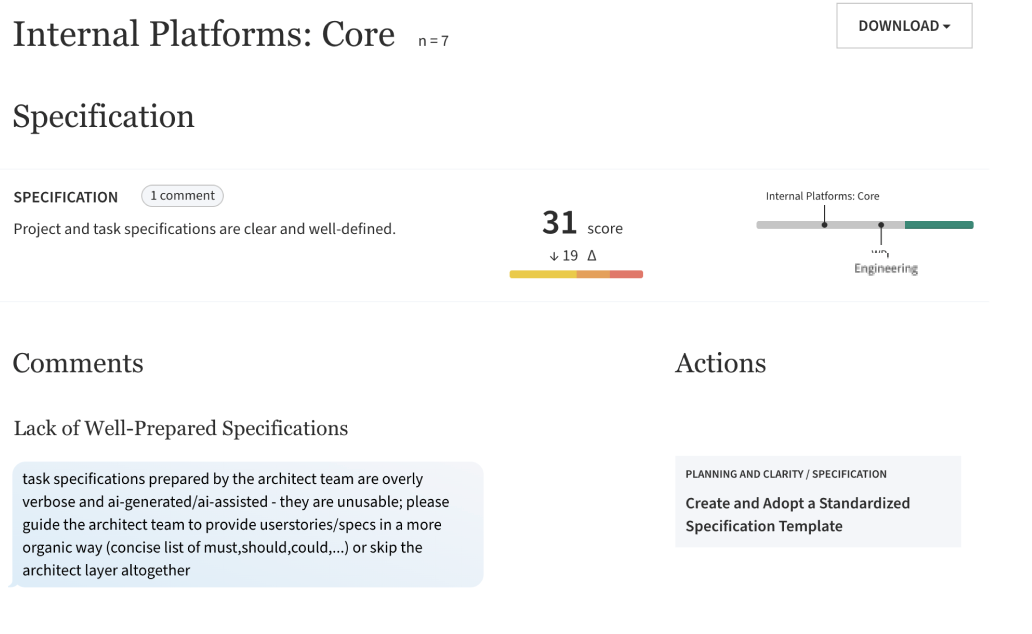
Because the problem was visible early, the team defined actions around:
- concise specification formats,
- Definition of Ready improvements,
- reducing AI-generated verbosity,
- strengthening architect–developer feedback loops.
Again, the survey transformed a vague frustration into a concrete improvement agenda.
From Measurement to Coordinated Improvement
These examples illustrate what we believe is the next evolution of Developer Experience. The goal is not simply collecting feedback. The goal is creating a system that continuously converts feedback into action.
That requires three things.First, teams need visibility into their own experience. Second, prioritization must become obvious. Teams should not need lengthy investigations to understand where friction originates. Third, insights must translate into concrete improvement opportunities that teams can own themselves.
When these three elements are present, Developer Experience becomes much more than a survey.
It becomes an operational feedback system for software delivery.
Why This Matters More in the Age of AI
As AI accelerates software implementation, delivery bottlenecks are increasingly shifting away from coding itself. Organizations are experiencing more friction around:
- review,
- comprehension,
- coordination,
- alignment,
- requirements quality,
- decision-making.
These challenges are difficult to detect through engineering metrics alone. They emerge from how people experience the delivery system. Which means they are exactly the kinds of problems Developer Experience is designed to reveal. The organizations that improve fastest will not necessarily be the ones collecting the most data.
They will be the ones that can move most quickly from: experience → understanding → action → improvement.
And that is ultimately the purpose of a modern DevEx system. Not measuring satisfaction.Helping engineering organizations continuously improve how software gets delivered.

